Archive
Can Dividends Pay for a Life of Doing Less?
Starting with my first dividend: what dividends, ex-dividend dates, price recovery, and living on dividends actually mean.
Let’s talk about dividends.
My first dividend arrived on May 22, 2019: 550 yuan from Ping An. I had held only 500 shares for less than two months, and each share paid 1.1 yuan. On July 11, I received my second dividend, 1,316 yuan from 1,400 shares of China Merchants Bank at 0.94 yuan per share.
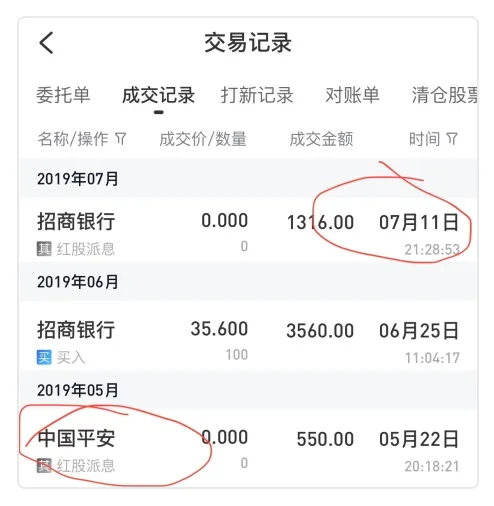
I had not expected it at all. I wonder how many people, like me then, do not realize that stocks can pay cash dividends.
My eyes lit up. It felt as if a beam of light had appeared on the horizon: if I invested more, could I eventually live on dividends alone?
Is that possible?
First, a few basics.
What Is a Dividend?
A dividend is a share of a company’s profit paid to investors according to the number of shares they own. It is a listed company’s return to shareholders, usually distributed after required reserves and other provisions. Dividends can be paid in cash, shares, or goods; cash is the most common and, in my view, the most useful form.

Moutai dividend record
Dividends may be quarterly or annual. In China’s A-share market, many listed companies pay at the half-year or year-end. Since annual reports are generally released by the end of April, May and June are peak dividend months.
Understanding the Ex-dividend Date
If dividend dates are known in advance, could you buy just before and sell just after to arbitrage them? No. Ex-dividend adjustments and income tax prevent it.
Suppose I own 1,000 shares of Company A at 10 yuan each, worth 10,000 yuan. Today A pays 10 yuan for every 10 shares, so I receive 1,000 yuan in cash. At the same time, A’s share price adjusts to 9 yuan, leaving the shares worth 9,000 yuan. My total assets are unchanged.
It can feel worse when you sell within a year, because dividend income is taxed at 10 to 20 percent. Holding for more than a year avoids the tax under the rule at the time.
So what is the point of dividends?
Understanding Price Recovery
Because a good company’s price can eventually rise again.
Suppose Company A performs steadily and pays 1 yuan per share every year. After the first dividend, investors who still expect that future 1-yuan payout will buy at a reasonable price. The share price rises again. That is price recovery after an ex-dividend adjustment.
Continuing the example: after the first dividend, you have 100 yuan in cash and 900 yuan in shares. In the second year, the company keeps growing earnings and its share price returns to 10 yuan. Before the next dividend, you have shares worth 1,000 yuan plus the 100 yuan cash dividend. That is the real return from a healthy business growing over time.
This is what I mean by earning from a company’s long-term growth.
For short-term traders, dividends have little meaning: total assets do not change, short-term price movements are unpredictable, and prices do not recover immediately. For long-term value investors, dividends matter. Reinvest them, own more shares, and receive more dividends the following year.
The Freedom to Lie Flat
How much would it take to reach a stage of financial ease? Here, “freedom” means annual dividends exceed annual spending. The other condition is owning several companies with stable, growing results and consistent dividends.

Take an average dividend yield of 4 percent and annual spending of 200,000 to 500,000 yuan. You would need 5 to 12.5 million yuan in stocks.
Then you would be roughly free, comrades.
Originally published on WeChat Official Account, read the original.
← Back to essays