Archive
Memories of a Retail Investor
Who has not been a small retail investor?
My flight was delayed, so I am sitting at the airport writing about my young, green years as a retail investor.
I opened my stock account on February 26, 2019. On March 4, I bought my first stock, China Merchants Bank, then other so-called blue chips such as Ping An and Gree.
At the time I had not read “63 Books,” and I had no real experience or system of my own. I mostly followed others on Xueqiu. Looking back, those first trades were not all wrong: I bought several good companies at low valuations, including CMB and Gree, and eventually sold them at a profit.
Then came the fourth stock I bought on March 26, 2019. It exposed this green retail investor completely.
It was HNA Holdings.
Yes, the company behind Hainan Airlines, which you may have flown too.
Here is the trade. I first bought 1,700 shares at 2.15 yuan. Over the next two months I made another 17 trades, buying 16,500 shares in total and putting in about 40,000 yuan, with an average cost just above 2 yuan.
After only three months, I sold everything in August at 1.88 yuan. I lost more than 5,000 yuan, roughly 14 percent.
It does not sound like a huge loss. Why do I remember it so clearly? Because the reasoning and psychology behind the purchase contained nearly every mistake a novice could make.
Not Knowing What Makes a Good Company
- I flew Hainan Airlines often and thought its service was good, so I naively assumed it was a good company.
- Aviation is actually a difficult industry: heavy long-term investment, exposure to oil, exchange rates, weather, and politics.
- The product has little differentiation; airlines fight on price and passengers have low loyalty.
- HNA Group expanded chaotically, borrowed from Peter to pay Paul, ran related-party transactions, and had a disordered management culture.
A Low Share Price Is Not a Cheap Company
- It was a big company whose shares cost just over 2 yuan, so I thought it looked cheap and easy to buy a lot of. Naive.
- I barely understood valuation and confused a share price with the company’s real value.
- I did not understand discounted cash flow, P/E, P/B, or other financial basics.
Typical Retail-Investor Psychology
- When the price fell after I bought, I kept buying to lower my average cost.
- Loss aversion: even after realizing I was obviously wrong, I did not want to sell. I wanted to wait.
You may know what happened next. HNA went through bankruptcy reorganization and was acquired by Fangda Group. While writing this, I looked at its share price again:
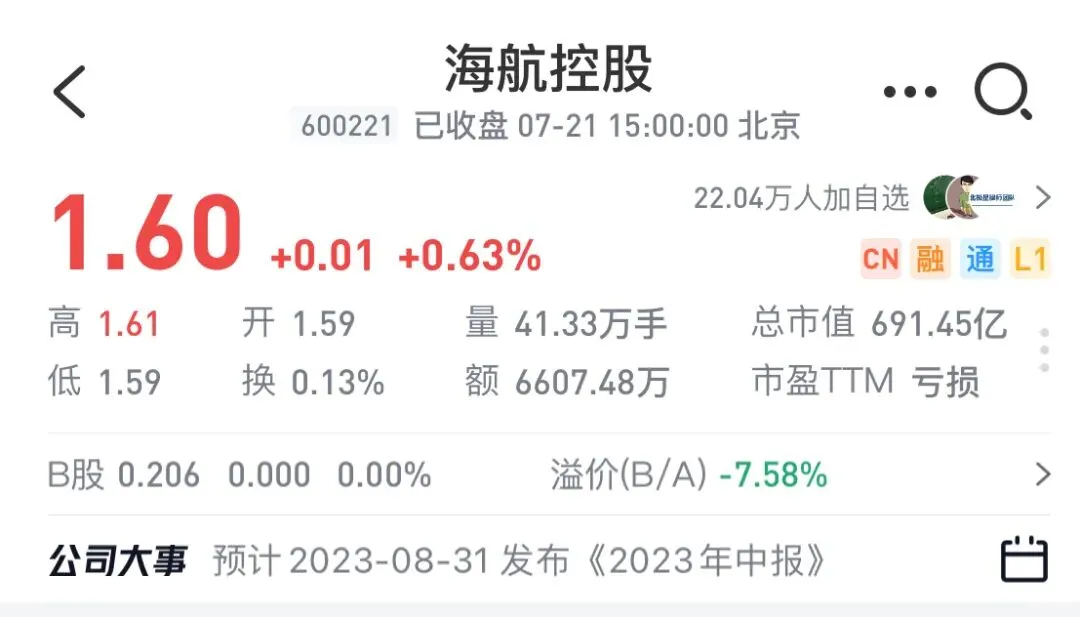
Take a deep breath.
My 7:30 flight had now been delayed until 11.
Another deep breath.
Next time, if I can take high-speed rail, I will take high-speed rail.
The point is: being a retail investor then does not mean I am not one now. At least I hope I am a much more evolved one.
Originally published on WeChat Official Account, read the original.
← Back to essays