Archive
Four Years of Investing: Gains and Losses of a Million
Four volatile years since 2019: a personal investing review, including market cycles, company cycles, and the psychology of holding on.
An essay I posted on the company intranet unexpectedly became popular. I was surprised and grateful, so I needed to keep the promise I had made.
This is not clickbait. Since buying my first stock, China Merchants Bank, on March 4, 2019, my account has at times shown unrealized losses in the millions of yuan. Still, after more than four years and three remarkably turbulent years, I can say: I am still here. I kept buying and trading, and I have become more convinced by the path of investing.
Where does that confidence come from?
Over four years, I lived through a full market cycle, watched several invested companies go through operating cycles, and—most importantly—learned, often painfully, about my own temperament and trading rhythm. This is the first piece of my investing record: not necessarily the densest guide, but a sincere one.
Investment Philosophy
Life is full of strange encounters. My earliest notions of “investment” were stock trading, buying property, and Yu’e Bao. They were not really understanding; they were hearsay and following the crowd. Today I prefer “investing” to “stock speculation,” because rumor-chasing and buying whatever rises are gambling and speculation.
Around 2019, during a short break after leaving my previous job, I found Li Xiaolai’s The Path to Financial Freedom left by a former tenant in a Beijing apartment. It is a genuinely good book obscured by its title. It led me to Graham, Buffett, Charlie Munger, Fisher, Peter Lynch, Duan Yongping, Li Lu, Tang Chao, Li Jie, and others.
Li Lu wrote that Munger’s success through wisdom, investment, self-cultivation, and learning gives readers in China a hopeful example: success can come through clean methods rather than privilege, fraud, or hidden rules. That idea moved me deeply.
Value investing has a simple core: buying a stock means buying a company. My version of the framework is this:
- Believe in the long-term development of the country and its companies. Stocks and property have historically been among the few assets that can outpace inflation.
- Earn from long-term business growth. Long-run U.S. market returns of roughly 8 percent reflect economic and corporate growth, which is also the logic behind index funds.
- Buy businesses with moats. To outperform, identify durable business models, competitiveness, management, and culture.
- Pay a good price. Mr. Market cannot be predicted. Shocks can misprice a company and create a margin of safety.
- Stay within a circle of competence and diversify with restraint. Hold perhaps seven or eight researched companies across industries, while concentrating 20 to 40 percent in the strongest convictions.
- Get rich slowly and build the temperament for it. Do not borrow, chase hot themes, or chase rumors. Be willing to buy when others are fearful, sit through bear markets, and hold through an operating cycle.
Investing is simple, but not easy. Knowing and doing are very different. That is why only a small minority can accept the framework and follow it consistently.
Market Cycles
People say you have not earned the right to talk about investing until you have lived through both bull and bear markets. They also say it takes a decade or more to distinguish skill from luck. Here are my returns across those first four years—nothing extraordinary, but they included the ride from a million yuan of paper gains to a million of paper losses.
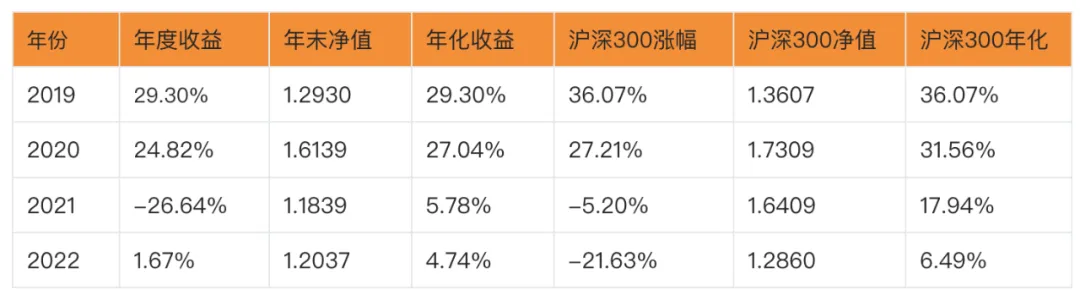
- From bull to bear. 2019 and 2020 felt like a smaller bull market. In 2021 the market turned down, and 2022 brought deeper declines amid the pandemic, U.S.–China tension, and the Russia–Ukraine war. My emotions went from complacency to panic and finally to calmer persistence.
- My first major market crash. On February 3, 2020, the index fell 8.43 percent at the open. It was the first time I had seen so many stocks fall together. I added to my holdings. Similar drops arrived again in the following two years, and if I had spare cash, I kept adding as long as the business itself had not changed.
- Six-figure daily moves. As capital grows, daily account swings grow too. Your mind has to grow through the same cycle of joy and grief. I hope one day everyone can look calmly at seven-figure daily moves; perhaps that would mean a certain kind of freedom.
Company Cycles
If buying stocks means buying companies, companies will rise and fall like people do. Choosing a stock is sometimes compared to choosing a life partner: there are objective measures, but subjective feeling is unavoidable. I generally avoid concept stocks because they often do not make money and I do not understand them. The harder part is staying with companies you still believe in while they go through difficulty.
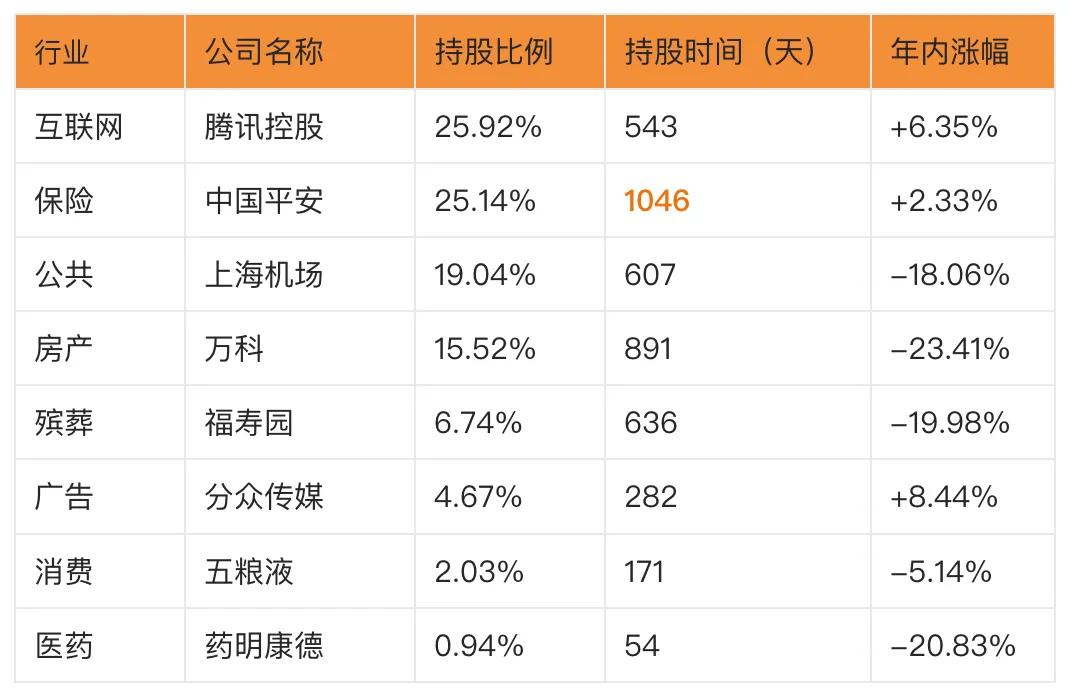
- Ping An. A leading life insurer was shifting from a broad-agent model toward a more elite model while integrating elder care and health resources. The reform was slower than expected and met the pandemic; the share price fell by more than half. I added.
- Vanke. A major property company faced industry-wide adjustment while moving from pure development into broader urban services, including commercial property, cold-chain logistics, and long-term rentals. Its share price also fell by more than half. I added.
- Tencent. The adjustment in Chinese internet stocks was unprecedented. I chose moments to build and add, because I still saw Tencent as the internet company with the strongest moat.
- Shanghai Airport. I saw it as a future international transfer hub with a strong moat in duty-free, advertising, and high-end traffic. The pandemic cut its share price heavily, but that was also the opening to buy at a lower price.
No one knows exactly how these companies will turn out. I believed Ping An’s reform could work because AIA had been through a related transition. I believed Vanke could adapt because housing is a vast market, and there are overseas examples such as Daiwa House.
Victory belongs to optimists.
Originally published on WeChat Official Account, read the original.
← Back to essays