Archive
My First Double-Bagger
A record of the first stock I followed through with using my own investment framework, ending in a gain of more than 100 percent.
Following my previous post, here is the first stock in which I completed an investment according to my own framework and exited successfully: Fuyao Glass.
It was my first full investment case after I developed that framework, so it is worth writing down as the second piece in this series.
The framework begins with one sentence: buying a stock means buying a company.
- China is entering an era in which equity matters more.
- The goal is to earn from a business’s long-term growth.
- Buy companies with real moats.
- Buy at a good price and leave room for a margin of safety.
- Stay in your circle of competence, diversify moderately, and concentrate in the best ideas.
- Get rich slowly: do not borrow, chase hot themes, or expect a miracle. Let companies live through their operating cycles.
Overall Return
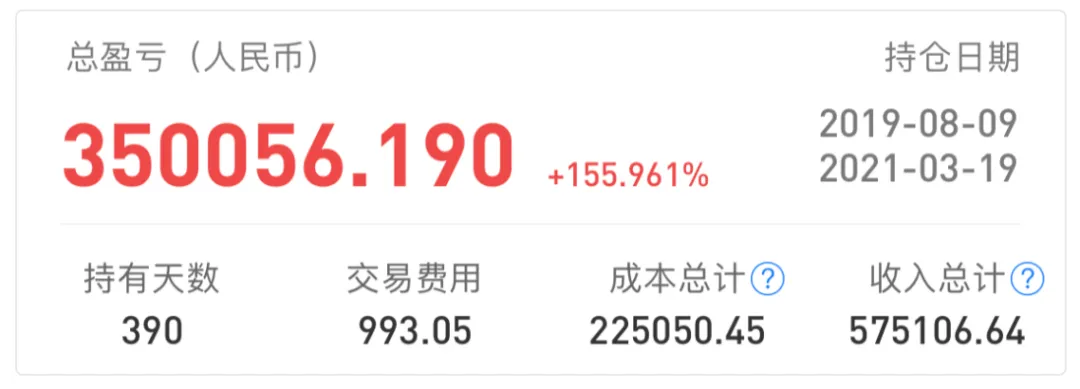
I bought in August 2019 and sold in March 2021, holding for 390 days. I invested 225,000 yuan and made 350,000 yuan, a return of 155.96 percent.
Choosing and Buying
I first learned about Fuyao through its founder, Cao Dewang, and his biography A Heart as Clear as Bodhi. I recommend it. Cao’s strength of purpose and focus reminded me of Jobs, and he was one reason I finally bought the company. But the business itself mattered more:
- The company. Founded in Fuzhou in 1987, it focused on automotive glass for thirty years and expanded into more than ten countries, changing the global industry’s shape.
- Management. The founder remained in place. I saw disciplined management and a culture of diligence, simplicity, and benefit to others.
- The industry. Fuyao was the domestic leader, with about 65 percent of the Chinese market and 23 percent globally at the time, behind only AGC of Japan. It had emerged from a difficult, unglamorous industry through hard work.
- Operations. Its return on equity was close to 18 percent, versus about 4 percent for AGC; gross margin held near 40 percent, well above an industry level around 25 percent. For manufacturing, those were outstanding figures.
- Moats. Major auto makers were customers. Long-term relationships, a full value-chain ecosystem, scale advantages, heavy upfront investment, factory location requirements, and technical barriers all made entry hard.
I concluded Fuyao was an excellent manufacturer with a global position that would be hard to shake. That made it a relatively safe way to earn from business growth.
The next question was valuation.
Fuyao historical P/E trend
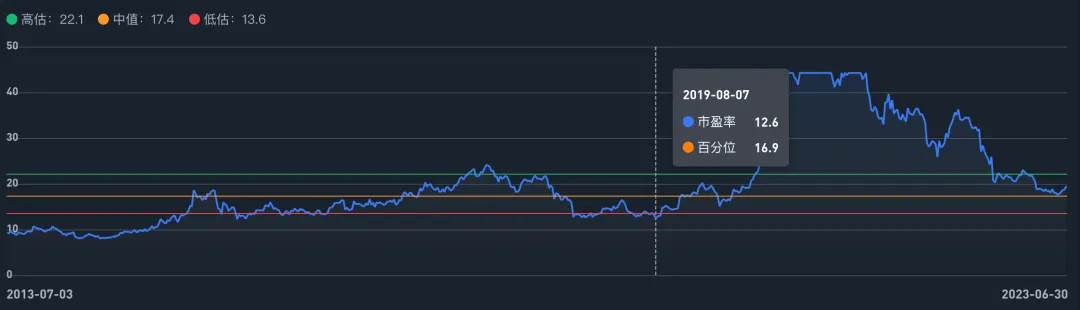
Because Fuyao had a stable operating and earnings history, P/E gave a useful rough picture. I began building the position around August 9, 2019, near a historical low valuation, then bought in tranches:
- My first purchase was at 20.95 yuan, around 12.5 times earnings and the 16.9th historical percentile, with a solid margin of safety.
- The opportunity largely came from the U.S.–China confrontation in 2018 and a low point in the auto cycle.
- The stock continued to fall after I bought, and the pandemic arrived in 2020. I kept buying in tranches; my lowest purchase was around 18.40 yuan.
Exit Strategy
My earlier essay had not addressed how to sell. This is subjective, and it bothered me for a long time. Traditional value investing emphasizes holding for the long term: Buffett has held Coca-Cola since 1988, while BYD rewarded Munger’s recommendation through a long and volatile ride.
Could ordinary people really do that? I cannot yet. It requires temperament and a depth of judgment about industries, strategy, and cycles that most of us do not have. At that stage, my own exit strategy rested on two ideas: obvious overvaluation and selling in tranches.
Fuyao historical P/E trend
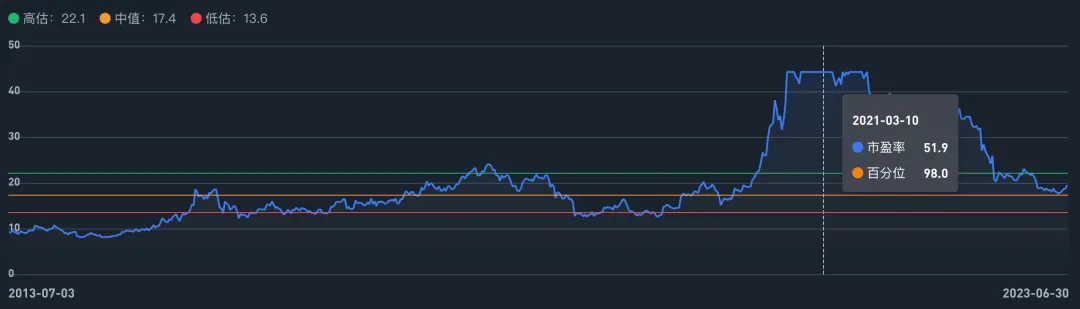
- The selling range in the chart was near a new historical high valuation, more than three times its average P/E.
- I sold the first third in January 2021 at 62 yuan, then sold the rest gradually at an average price in the fifties.
Everyone can set an exit price and a staged selling plan in advance. That retains some upside while allowing a gain to be realized.
Two other rules complete my current exit strategy:
- Sell quickly when you are wrong. Do not let loss aversion make you hold and add endlessly to lower the cost.
- Switch when a better opportunity appears. If there is a company or situation you understand better, it can make sense to reallocate.
Neither rule is easy. That is a story for another time.
Originally published on WeChat Official Account, read the original.
← Back to essays